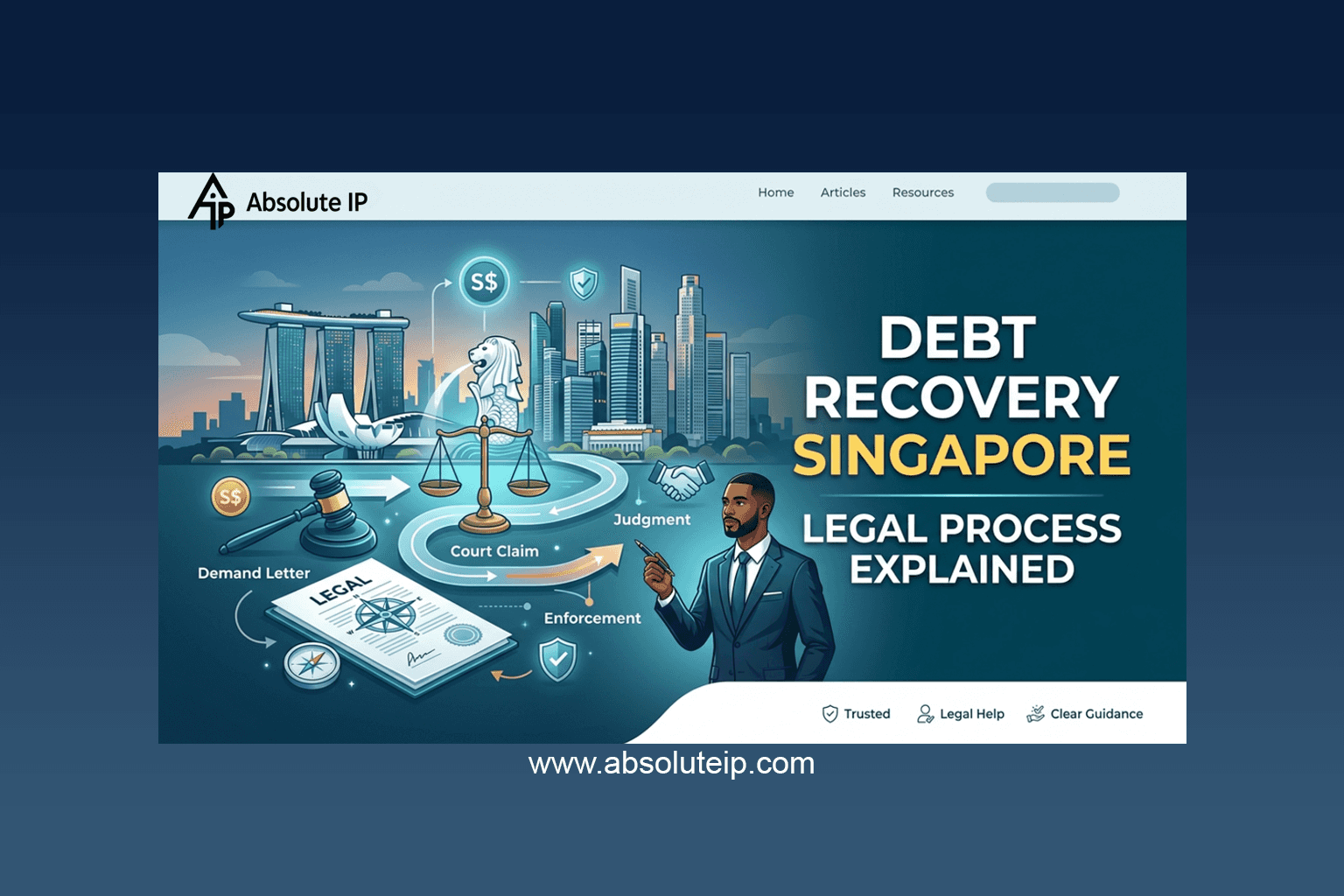
Debt Recovery Singapore: Legal Process Explained for Businesses
Learn the debt recovery legal process in Singapore, including payment reminders, letters of demand, Small Claims Tribunals, civil claims, enforcement, and insolvency options.

Hannah Poh
Corporate Lawyer
Debt Recovery Singapore: Legal Process Explained
Unpaid debts can create serious cash flow problems for businesses in Singapore. Whether the issue involves unpaid invoices, rental arrears, service fees, supplier payments, loan repayments, project claims, or commercial debts, a business should know how to respond properly.
Debt recovery is not only about chasing payment. It involves evidence, contracts, negotiation, letters of demand, legal proceedings, enforcement, and sometimes insolvency considerations.
Many businesses make the mistake of waiting too long, sending informal reminders without proper records, or escalating emotionally without understanding the legal process. A structured approach improves the chance of recovery and reduces unnecessary cost.
This guide explains the debt recovery legal process in Singapore and what businesses should do when another party fails to pay.
What is Debt Recovery in Singapore
Debt recovery refers to the process of recovering money owed by another party.
This may involve debts owed by:
Customers
Clients
Tenants
Suppliers
Contractors
Business partners
Borrowers
Companies
Individuals
Debt recovery may arise from:
Unpaid invoices
Breach of contract
Loan agreements
Service agreements
Rental arrears
Purchase orders
Project claims
Goods sold and delivered
Professional fees
Settlement agreements
If your business needs support with insolvency, debt restructuring and recovery
it is important to assess both the legal merits of the claim and the debtor’s ability to pay.
Is Debt Recovery a Civil or Criminal Matter
Most debt recovery matters in Singapore are civil matters.
This means the creditor usually needs to pursue payment through negotiation, demand letters, court or tribunal proceedings, enforcement, or insolvency-related action.
A debt usually does not become a criminal matter just because someone refuses to pay.
However, if there is fraud, cheating, deception, or criminal conduct, separate issues may arise.
For most commercial debts, businesses should focus on civil recovery options.
Why Businesses Should Act Early
Delay can reduce recovery prospects.
Businesses should act early because:
The debtor may become insolvent
Records may become harder to retrieve
Witnesses may forget details
Limitation periods may become an issue
The debtor may transfer assets
Cash flow pressure may worsen
Informal promises may not lead to payment
Negotiation leverage may decrease
A business should not ignore repeated non-payment.
Step 1: Review the Debt Documents
Before taking action, review the documents supporting the debt.
Useful documents may include:
Signed contract
Purchase order
Quotation
Invoice
Delivery order
Statement of account
Email correspondence
WhatsApp messages
Proof of work done
Payment reminders
Receipts
Acknowledgement of debt
Loan agreement
Tenancy agreement
Settlement agreement
A debt recovery claim is much stronger when the creditor can show what was agreed, what was delivered, what is owed, and when payment became due.
For contract planning, read business contracts Singapore guide
Step 2: Check the Payment Terms
The next step is to confirm the payment terms.
You should check:
Amount owed
Due date
Interest clause
Late payment clause
Credit period
Milestone payment terms
Goods or services delivered
Whether there are disputed items
Whether set-off is claimed
Whether the debtor has raised complaints
Whether the debtor acknowledged the debt
Some debts are disputed because the contract terms are unclear.
A clear contract makes debt recovery easier.
Step 3: Send Payment Reminders
Before legal escalation, many businesses send reminders.
A payment reminder should be:
Clear
Polite
Written
Specific
Supported by invoice details
Time-limited
Preserved as evidence
A reminder may include:
Invoice number
Outstanding amount
Due date
Payment instructions
Deadline for response
Request for explanation if payment is disputed
Avoid vague messages such as “please pay soon”. Instead, specify what is owed and by when.
Step 4: Consider Negotiation or Payment Plan
If the debtor admits the debt but cannot pay immediately, negotiation may be useful.
Options may include:
Instalment payment plan
Partial settlement
Extended deadline
Security for payment
Personal guarantee
Acknowledgement of debt
Settlement agreement
Post-dated cheques where appropriate
Suspension of services until payment
If a payment plan is agreed, it should be documented properly.
A written payment plan should include:
Total amount owed
Payment schedule
Consequences of default
Interest or costs, if any
Whether services continue
Whether legal rights are reserved
Signatures or written confirmation
Step 5: Send a Letter of Demand
A letter of demand is a formal written demand for payment.
It usually states:
Who owes the debt
Amount owed
Basis of the claim
Relevant invoices or contracts
Payment deadline
Consequences of non-payment
Reservation of legal rights
A letter of demand can show seriousness and may prompt payment without court action.
For business owners, a properly drafted letter of demand is often more effective than repeated informal chasing.
Step 6: Decide Whether the Claim is Suitable for Small Claims Tribunals
Some lower-value disputes may be suitable for the Small Claims Tribunals.
The Singapore Judiciary states that common types of small claims include disputes involving goods, services, or residential tenancy agreements not exceeding 2 years. The claim limit is generally $20,000, or $30,000 if both parties sign a Memorandum of Consent.
The Judiciary also confirms that claims with a total value not exceeding $20,000 can be heard at the Small Claims Tribunals, with the limit raised to $30,000 if both parties consent.
Small Claims Tribunals may be suitable for:
Service fee disputes
Goods sold disputes
Consumer-related claims
Certain residential tenancy disputes
Lower-value payment disputes
However, not every business debt is eligible.
For more detail, read small claims tribunal Singapore guide
Step 7: Consider a Civil Claim
If the debt is not suitable for Small Claims Tribunals, a creditor may need to consider a civil claim.
Civil claims may be used for:
Larger debts
Complex contract disputes
Commercial debts
Loan disputes
Business-to-business claims
Claims involving companies
Disputed invoices
Claims requiring legal representation
A civil claim generally involves court procedures, pleadings, evidence, timelines and possible trial if the matter is not settled.
The appropriate forum depends on the claim amount and nature of the dispute.
Businesses should assess whether legal action is commercially worthwhile by considering:
Amount owed
Strength of evidence
Debtor’s ability to pay
Likelihood of dispute
Legal cost
Time required
Commercial relationship
Urgency
Step 8: Understand Defences to Debt Claims
A debtor may dispute the debt.
Common defences include:
Goods or services were defective
Work was incomplete
Payment was already made
Amount claimed is wrong
Contract was varied
There was no agreement
Claim is time-barred
Debtor has a set-off
Invoice was not approved
Wrong legal entity was invoiced
Services were not authorised
Before filing a claim, the creditor should anticipate possible defences.
Good documentation is critical.
Step 9: Obtain Judgment or Settlement
A debt recovery matter may end in:
Voluntary payment
Payment plan
Settlement agreement
Consent judgment
Court judgment
Tribunal order
Withdrawal after payment
Mediation settlement
A judgment confirms that the debtor owes the amount.
However, obtaining judgment does not always mean immediate payment.
If the debtor still refuses to pay, enforcement may be required.
Step 10: Enforce the Judgment
If a creditor obtains a judgment or order and the debtor does not comply, enforcement may be necessary.
The Singapore Judiciary explains that a party may enforce an order or judgment in different ways if the other party fails to comply, and provides guidance on enforcement procedures depending on the applicable Rules of Court.
Enforcement options may include:
Seizure and sale of property
Garnishee or attachment of debts
Examination of judgment debtor
Enforcement against bank accounts where available
Other court enforcement processes
The appropriate enforcement method depends on the debtor’s assets and circumstances.
Step 11: Consider Statutory Demand
A statutory demand may be relevant where the debtor is insolvent or refusing to pay an undisputed debt.
The Singapore Judiciary provides guidance on serving a statutory demand on a debtor and states that the statutory demand should be prepared in accordance with Form PIR-2 under the Insolvency, Restructuring and Dissolution (Personal Insolvency) Rules.
For corporate debt, statutory demands and winding-up considerations may arise under the Insolvency, Restructuring and Dissolution Act.
Statutory demand should not be used casually.
It may be inappropriate if:
The debt is genuinely disputed
The debtor has a substantial cross-claim
The amount is unclear
The creditor is using insolvency pressure improperly
The objective is debt collection rather than genuine insolvency response
For insolvency-related support, read insolvency, debt restructuring and recovery
Step 12: Consider Winding Up or Bankruptcy Only Where Appropriate
If a debtor company cannot pay its debts, winding-up action may be considered.
If an individual debtor cannot pay, bankruptcy-related procedures may be considered.
These are serious steps.
They should be considered carefully because insolvency proceedings are not simply ordinary debt collection tools.
Before taking insolvency action, consider:
Whether the debt is undisputed
Whether the debtor is genuinely insolvent
Whether there are assets to recover
Whether insolvency action is proportionate
Whether settlement is possible
Whether the debtor has other creditors
Whether legal requirements are satisfied
Businesses should seek advice before using insolvency procedures.
Debt Recovery Against Companies
Recovering debt from a company may involve:
Checking the company’s ACRA profile
Confirming the correct legal entity
Reviewing contract and invoice details
Sending a letter of demand
Considering civil proceedings
Considering statutory demand
Considering winding up if appropriate
Enforcing judgment against company assets
A company’s directors are not automatically personally liable for company debts unless there is a personal guarantee, fraud, breach of duty or other legal basis.
Debt Recovery Against Individuals
Recovering debt from individuals may involve:
Reviewing loan documents
Checking written acknowledgements
Sending a demand letter
Considering Small Claims Tribunals where eligible
Filing civil claim where appropriate
Enforcing judgment
Considering statutory demand or bankruptcy where appropriate
Individual debt recovery can be sensitive because personal financial circumstances may affect recovery strategy.
Debt Recovery for Landlords
Landlords may need to recover:
Rental arrears
Service charge
Utility payments
Reinstatement costs
Repair costs
Damage compensation
Legal costs, where recoverable
For tenancy-related issues, read landlord tenant law Singapore complete guide
For business leases, read commercial lease agreement Singapore explained
Debt Recovery for Contractors and Service Providers
Contractors and service providers often face unpaid invoices.
Common issues include:
Client says work was incomplete
Client delays approval
Client disputes variation orders
Client claims defects
Client refuses milestone payment
Client uses the work but refuses payment
Client asks for repeated revisions without payment
Businesses should ensure contracts include:
Clear scope of work
Payment milestones
Variation order process
Late payment consequences
Suspension rights
Acceptance criteria
Dispute resolution clauses
For broader legal risk planning, read common legal mistakes businesses make in Singapore
🟥 BACKLINK: /blog/common-legal-mistakes-business-singapore
Debt Recovery and Business Restructuring
Sometimes a debtor is not refusing to pay, but genuinely facing cash flow problems.
In those cases, debt recovery may overlap with restructuring.
Possible options include:
Payment plan
Debt compromise
Debt restructuring agreement
Security for payment
Settlement agreement
Corporate restructuring
Insolvency process
If the debtor is financially distressed, read corporate restructuring Singapore
Debt Recovery and Online Reputation
Debt disputes can become emotional.
Businesses should avoid posting public accusations about debtors online before the facts are properly assessed.
Public posts may create issues involving:
Defamation
Confidentiality
Harassment
Business reputation
Settlement difficulty
Counterclaims
For online reputation risks, read Huang Yiliang hawker dispute rumours, online reviews and business reputation
For brand protection issues, read Huang Yiliang hawker dispute online reviews and brand protection in Singapore
Common Debt Recovery Mistakes
Businesses often make avoidable mistakes when chasing debts.
Mistake 1: Not Having a Written Contract
Without a written contract, disputes become harder to prove.
Mistake 2: Invoicing the Wrong Legal Entity
The creditor must claim against the correct debtor.
Mistake 3: Waiting Too Long
Delay may reduce recovery chances.
Mistake 4: Not Keeping Evidence
Emails, invoices, delivery records and messages are important.
Mistake 5: Accepting Payment Plans Without Written Terms
A vague payment plan may create further disputes.
Mistake 6: Using Threatening or Emotional Messages
Debt recovery should remain professional and evidence-based.
Mistake 7: Starting Legal Action Without Checking Ability to Pay
A judgment may be difficult to recover if the debtor has no assets.
Mistake 8: Using Insolvency Threats for Genuinely Disputed Debts
Statutory demands and insolvency processes should be used carefully.
Debt Recovery Checklist for Businesses
Before escalating a debt recovery matter, review:
Is there a written contract?
Is the correct legal entity identified?
What is the exact amount owed?
When was payment due?
Are invoices and statements available?
Was the work delivered?
Did the debtor raise any dispute?
Has the debt been acknowledged?
Are there emails or messages supporting the claim?
Was a payment reminder sent?
Should a letter of demand be issued?
Is the claim suitable for Small Claims Tribunals?
Is a civil claim commercially worthwhile?
Can the debtor pay?
Is enforcement likely to be effective?
Is insolvency action appropriate?
For a wider business legal checklist, read business legal checklist Singapore
Why Work with Absolute IP
Debt recovery requires both legal strategy and commercial judgment.
Absolute IP helps businesses with:
Debt recovery strategy
Letters of demand
Contract review
Payment dispute assessment
Settlement negotiation
Civil claims
Enforcement options
Insolvency and restructuring issues
Commercial dispute resolution
Landlord and tenant payment disputes
If your business is facing unpaid invoices, rental arrears, loan defaults or commercial debts, contact Absolute IP at support@absoluteip.com for practical legal guidance.
Conclusion
Debt recovery in Singapore requires a structured legal process.
Businesses should begin by reviewing documents, confirming payment terms, sending reminders, considering negotiation, issuing a letter of demand, and assessing whether the matter should proceed to Small Claims Tribunals, civil court, enforcement or insolvency-related action.
The best approach depends on the amount owed, strength of evidence, debtor’s financial position and commercial context.
Acting early, keeping proper records and using clear contracts can greatly improve recovery prospects.