How to Register a Trademark in Singapore: Step-by-Step Guide
A step-by-step guide for startups, SMEs and creators on how to register a trademark in Singapore and protect a brand name, logo or business identity.

Hannah Poh
Corporate Lawyer
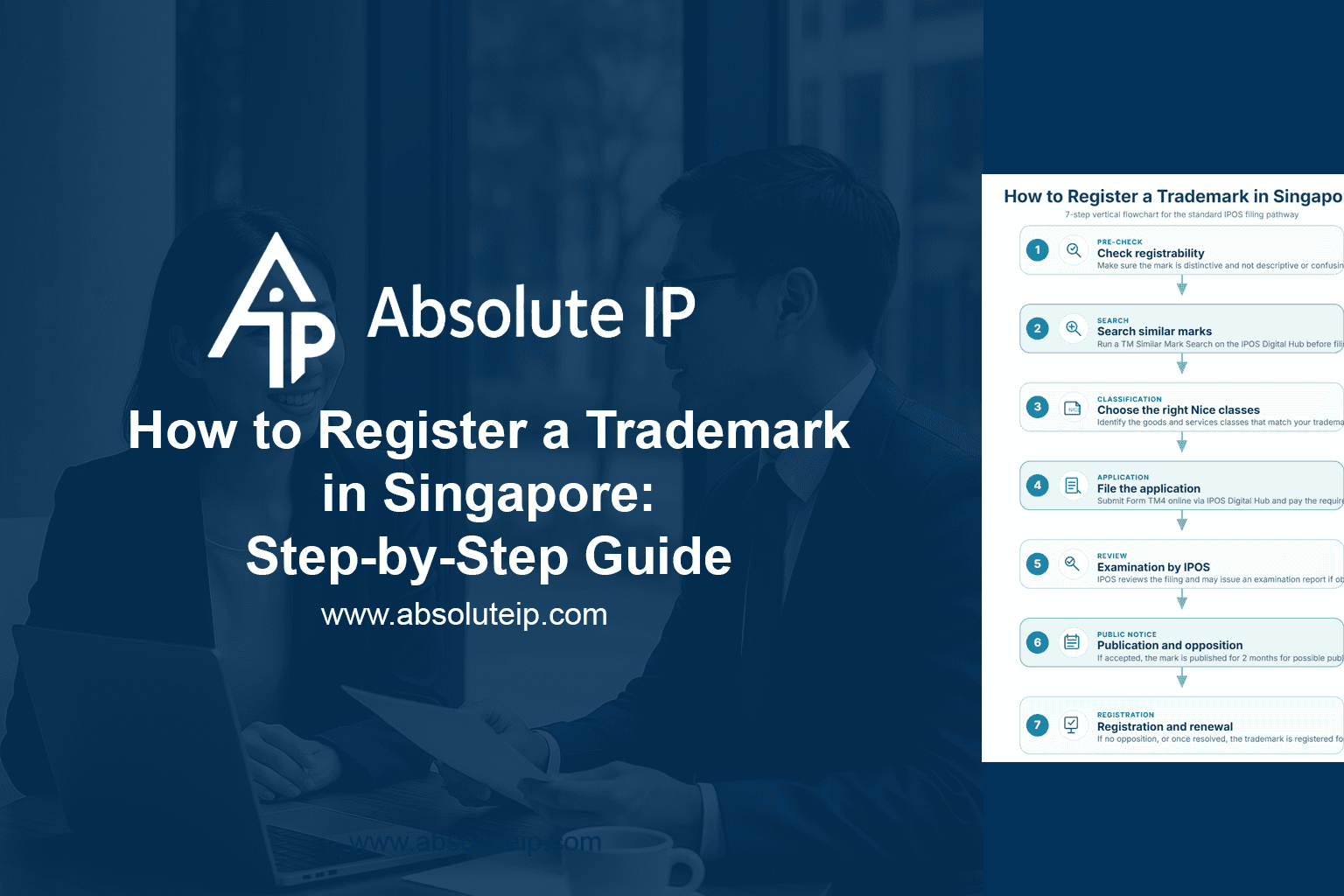
How to Register a Trademark in Singapore: Step-by-Step Guide
If you are building a business, launching a product, creating a brand or growing an online store, your brand name and logo can quickly become valuable assets.
Trademark registration in Singapore helps protect your brand identity and gives you stronger rights over your mark. For startups, SMEs, creators and business owners, registering a trademark early can reduce the risk of copycats, brand disputes and costly rebranding later.
This guide explains how to register a trademark in Singapore, what steps are involved, and what business owners should prepare before filing.
Need help with trademark registration in Singapore? Contact Absolute IP at support@absoluteip.com.
What Is a Trademark?
A trademark is a sign that helps distinguish one business’s goods or services from another.
It can include:
Brand names
Business names
Logos
Product names
Service names
Slogans
Taglines
Symbols
Distinctive visual elements
A trademark helps customers recognise your business in the market. Once registered, it can give the owner stronger protection over the mark for the goods or services covered by the registration.
Step 1: Decide What You Want to Protect
Before filing, decide what part of your brand should be protected.
You may want to register:
Your brand name
Your logo
Both the brand name and logo
A product name
A service name
A tagline or slogan
A word mark protects the name itself. A logo mark protects the visual design. Some businesses may only need one filing at the beginning, while others may want to protect both.
For many startups and SMEs, the brand name is usually the priority because it is what customers remember, search for and associate with the business.
Step 2: Check Whether Your Trademark Is Distinctive
Not every name or logo can be registered.
A strong trademark should be distinctive. This means it should be able to identify your goods or services as coming from your business.
Marks that are too generic or descriptive may face difficulties.
For example, a name that simply describes the product or service may be harder to protect. A more unique, invented or distinctive name is usually stronger.
Before filing, consider:
Is the name unique?
Is it too descriptive?
Is it commonly used in your industry?
Could customers confuse it with another brand?
Does it clearly identify your business?
Choosing a distinctive mark from the start can improve your chances of protection.
Step 3: Conduct a Trademark Search
A trademark search helps identify whether there are earlier trademarks that may conflict with your proposed mark.
This is an important step because filing without a search can lead to problems later.
A search may reveal:
Identical trademarks
Similar trademarks
Earlier applications
Marks in related classes
Potential conflict risks
Names that may be difficult to register
A trademark search does not guarantee approval, but it helps reduce the risk of filing blindly.
This step is especially important if you have already invested in branding, packaging, signage, social media handles, websites or marketing campaigns.
If you are unsure whether your proposed brand is safe to file, Absolute IP can assist with trademark search and filing strategy. Contact support@absoluteip.com.
Step 4: Identify the Correct Trademark Class
Trademark applications are filed according to classes of goods and services.
This is one of the most important parts of the application.
A business selling clothing, a software company, a café, a consultancy and an education provider may all fall under different classes. Some businesses may need more than one class.
Choosing the wrong class can weaken the value of the registration. Filing in too few classes may leave important areas of your business unprotected. Filing in too many classes may increase cost unnecessarily.
Examples:
A fashion brand may need protection for clothing.
A software business may need protection for software services.
A café may need protection for food and beverage services.
A training provider may need protection for education services.
An agency may need protection for consulting or marketing services.
Your trademark class should match how your brand is actually used or intended to be used.
Step 5: Prepare the Trademark Application
Once the mark and class are ready, the application needs to be prepared.
A trademark application usually includes:
Applicant details
Representation of the trademark
Trademark class or classes
Description of goods or services
Filing details
Supporting information where required
Accuracy matters. If the goods and services are unclear, too broad or wrongly classified, the application may face issues.
For business owners, the goal is not just to file quickly. The goal is to file properly so the registration gives useful commercial protection.
Step 6: File the Application with IPOS
Trademark applications in Singapore are filed with the Intellectual Property Office of Singapore, also known as IPOS.
After filing, the application will be examined. If there are issues, IPOS may raise objections or ask for clarification.
A straightforward application may move through the process more smoothly. If the mark has problems, the applicant may need to respond with arguments, amendments or supporting explanations.
Step 7: Examination by IPOS
During examination, IPOS reviews the application.
Common issues may include:
The mark is too descriptive
The mark lacks distinctiveness
The goods or services are unclear
The mark is similar to an earlier trademark
The application contains technical issues
The mark may mislead consumers
If objections are raised, the applicant may need to respond within the required timeline.
This is where professional support can be helpful, especially if the objection involves legal arguments, earlier marks or technical classification issues.
Step 8: Publication and Opposition Period
If the application is accepted, it will usually be published for opposition.
This allows third parties to object if they believe your trademark should not be registered.
For many applications, no opposition is filed. If opposition does arise, the matter may involve formal procedures, evidence and legal arguments.
This is one reason why an early trademark search is useful. It helps identify possible conflicts before filing.
Step 9: Registration
If there are no unresolved objections or oppositions, the trademark may proceed to registration.
Once registered, the trademark owner has stronger rights over the mark in relation to the goods or services covered by the registration.
This can support:
Brand protection
Business expansion
Licensing
Franchising
Investor confidence
Marketplace enforcement
Legal action against copycats
Overseas expansion planning
For businesses building long-term brand value, registration is an important step.
Common Mistakes When Registering a Trademark
Many businesses make avoidable mistakes when filing trademarks.
Common mistakes include:
Assuming company registration protects the brand
Skipping the trademark search
Choosing a descriptive brand name
Filing under the wrong class
Protecting only the logo but not the brand name
Waiting until the brand becomes valuable
Ignoring overseas markets
Using vague goods or services descriptions
These mistakes can weaken protection or create problems later.
Can You Register a Trademark Yourself?
Yes, business owners can file a trademark themselves.
However, trademark registration involves more than filling in a form. You need to consider distinctiveness, trademark search results, class selection, goods and services descriptions, possible objections and long-term business plans.
Self-filing may be suitable if the mark is simple and the business owner understands the process. For many startups and SMEs, professional guidance helps reduce avoidable mistakes.
When Should You Register a Trademark?
The best time to consider trademark registration is before the brand becomes widely used.
You should consider filing when:
You are launching a new business
You are investing in branding
You are building a website
You are selling products online
You are preparing packaging
You are opening a physical outlet
You are raising funds
You are franchising
You are expanding overseas
You are worried about copycats
Waiting too long may create risk, especially if another party files a similar mark first.
Why Choose Absolute IP?
Absolute IP helps startups, SMEs, creators and business owners register trademarks in Singapore and protect their brand identity.
We support businesses with:
Trademark search
Class selection
Application preparation
IPOS filing support
Brand name protection
Logo protection
Trademark objections
Copyright and IP advisory
Licensing and franchising considerations
Broader brand protection strategy
Our approach is practical, business-focused and designed for companies that want to protect what they are building.
For trademark registration support, contact Absolute IP at support@absoluteip.com.
Frequently Asked Questions
How do I register a trademark in Singapore?
You register a trademark by checking whether the mark is suitable, identifying the correct class, preparing the application and filing it with IPOS. The application will then be examined and may proceed to publication and registration.
Do I need to do a trademark search before filing?
A trademark search is strongly recommended because it helps identify earlier marks that may conflict with your proposed trademark.
Can I register my business name as a trademark?
Yes, a business name may be registered as a trademark if it is distinctive and does not conflict with earlier marks.
Can I register my logo as a trademark?
Yes, a logo may be registered if it is distinctive and meets the registration requirements.
Is company registration the same as trademark registration?
No. Company registration identifies your legal entity. Trademark registration protects your brand identity for specific goods or services.
How long does trademark registration take in Singapore?
The timeline depends on whether the application is straightforward. If objections or oppositions arise, the process may take longer.
How much does trademark registration cost in Singapore?
The cost depends on the number of classes, type of mark, filing strategy and whether objections or additional work arise.
Can I register a trademark myself?
Yes, but professional support can help reduce mistakes in class selection, filing details, search review and response to objections.
What happens if my trademark is rejected?
If objections are raised, you may need to respond with arguments, amendments or supporting explanations. The next steps depend on the reason for the objection.
Should I register my trademark overseas?
Singapore trademark registration protects your mark in Singapore. If you plan to expand overseas, sell internationally or franchise your brand, overseas trademark protection should be considered.
Speak to Absolute IP
Trademark registration is one of the most practical ways to protect your brand name, logo and business identity.
If you are preparing to launch a brand, grow your business or protect an existing name, Absolute IP can help you review your options and take the next step.
For trademark registration in Singapore, contact Absolute IP at support@absoluteip.com.