Mergers and Acquisitions Singapore Process Explained for Business Owners
Learn the mergers and acquisitions process in Singapore, including due diligence, sale agreements, share transfers, stamp duty, employment issues, IP review and completion.

Hannah Poh
Corporate Lawyer
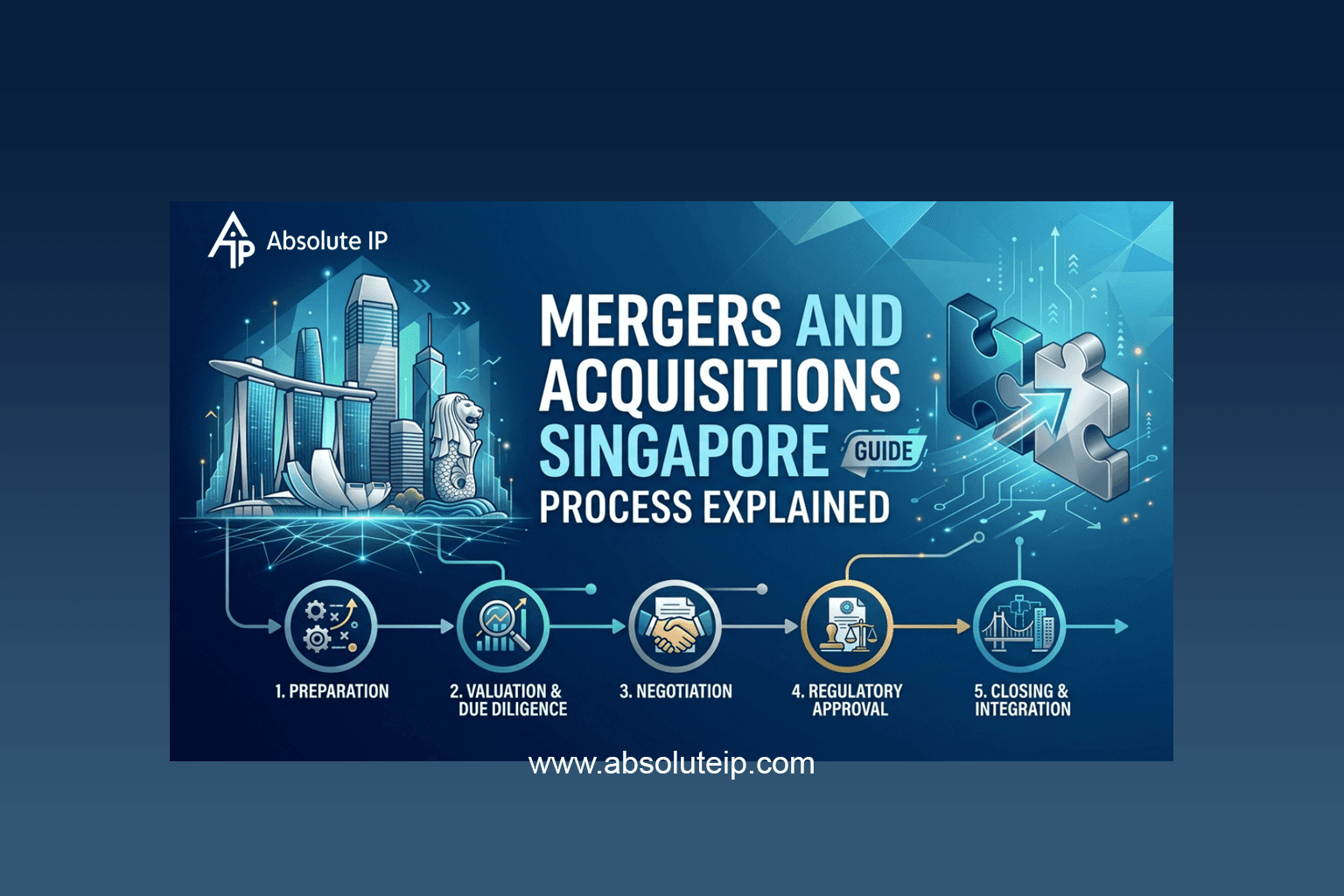
Mergers and Acquisitions Singapore Process Explained for Business Owners
Mergers and acquisitions, commonly referred to as M&A, are important transactions for business growth, restructuring, investment and exit planning. In Singapore, M&A transactions may involve buying shares in a company, acquiring business assets, merging operations, bringing in investors, selling a business, restructuring a group, or transferring ownership between shareholders.
For business owners, the M&A process can feel complex because it involves legal, financial, tax, operational, employment, intellectual property and commercial issues.
A successful transaction is not only about agreeing on price. It also requires proper due diligence, clear transaction documents, regulatory checks, completion mechanics, and post-completion planning.
This guide explains the mergers and acquisitions process in Singapore and what business owners should understand before buying or selling a company.
What Are Mergers and Acquisitions
Mergers and acquisitions refer to transactions where one business combines with, purchases, invests in, or takes control of another business.
In practice, Singapore M&A transactions may include:
Share acquisitions
Asset acquisitions
Business transfers
Joint ventures
Management buyouts
Investor buy-ins
Group restructurings
Sale of subsidiaries
Strategic partnerships
The exact structure depends on the commercial objective, tax considerations, liabilities, regulatory requirements and negotiation between parties.
If your business needs support with mergers and acquisitions corporate transactions
it is important to review the transaction structure before signing binding documents.
Common M&A Structures in Singapore
There are two common structures for acquiring a business in Singapore: share purchase and asset purchase.
Share Purchase
In a share purchase, the buyer acquires shares in the target company.
The company continues to exist, but ownership changes.
This means the buyer usually acquires the company together with its assets, contracts, employees, licences, liabilities and historical issues.
A share purchase may be simpler operationally because contracts and assets remain within the same legal entity. However, the buyer must be careful about hidden liabilities.
ACRA notes that share transfers must be filed within 14 days to notify ACRA, and for private companies, share transfers take effect only once ACRA’s electronic register of members is updated upon filing.
Asset Purchase
In an asset purchase, the buyer acquires selected assets or business lines from the seller.
These assets may include:
Equipment
Inventory
Contracts
Customer lists
Intellectual property
Business records
Goodwill
Software
Domain names
Licences where transferable
An asset purchase allows the buyer to choose what it wants to acquire, but it may require more detailed transfer steps. Contracts, employees, licences and assets may need to be transferred individually.
Step 1: Define the Commercial Objective
Before beginning an M&A transaction, the parties should define the commercial objective.
For a buyer, the objective may be:
Business expansion
Customer acquisition
Technology acquisition
Market entry
Talent acquisition
Competitor acquisition
Brand acquisition
Strategic investment
For a seller, the objective may be:
Exit planning
Succession
Fundraising
Partial sale
Group restructuring
Debt management
Strategic partnership
The commercial objective affects deal structure, valuation, due diligence and negotiation strategy.
Step 2: Sign a Non-Disclosure Agreement
Before sharing sensitive business information, parties often sign a non-disclosure agreement.
This protects confidential information such as:
Financial records
Customer lists
Supplier terms
Employee data
Business plans
Contracts
Trade secrets
Technical information
Source code
Pricing
Intellectual property
Confidentiality is especially important during M&A because the buyer may be a competitor, investor, customer, supplier or strategic partner.
For contract drafting principles, read business contracts Singapore guide
Step 3: Sign a Letter of Intent or Term Sheet
Before the final agreement, parties may sign a letter of intent or term sheet.
This document may outline:
Purchase price
Transaction structure
Due diligence period
Exclusivity period
Conditions precedent
Confidentiality
Timeline
Key commercial terms
Non-binding and binding clauses
A term sheet helps parties align before spending time and cost on full documentation.
However, some clauses may be legally binding, such as confidentiality, exclusivity and governing law. Parties should review the document carefully before signing.
Step 4: Conduct Due Diligence
Due diligence is one of the most important stages in an M&A transaction.
The buyer reviews the target business to understand risks, liabilities and value.
Due diligence may cover:
Corporate records
Shareholding structure
Financial statements
Tax filings
Material contracts
Employment matters
Litigation
Debt
Licences
Intellectual property
Data protection
Real estate
Regulatory compliance
Technology systems
A proper due diligence process helps the buyer decide whether to proceed, renegotiate, request warranties or require conditions before completion.
Step 5: Review Corporate Records and Shareholding
For share acquisitions, the buyer should confirm the company’s corporate structure and shareholding.
This may include reviewing:
ACRA records
Company constitution
Share certificates
Shareholder agreements
Board minutes
Share transfer history
Directors and officers
Charges and encumbrances
Outstanding options or convertible instruments
If the company has multiple shareholders, the buyer should review whether there are rights of first refusal, tag-along rights, drag-along rights or consent requirements.
For founder and shareholder issues, read shareholder agreement Singapore guide
Step 6: Review Financial and Tax Matters
Financial and tax due diligence helps identify whether the target’s financial position matches the seller’s representations.
This may include:
Revenue records
Profit and loss statements
Balance sheets
Cash flow
Debts
Receivables
Payables
Tax filings
GST issues
Related-party transactions
Contingent liabilities
The buyer should understand whether there are unpaid taxes, unusual liabilities or accounting issues.
For share transfers, IRAS states that stamp duty is payable on the actual price or net asset value of the shares, whichever is higher. IRAS also states that stamp duty for transfer of shares is 0.2% of the purchase price or value of shares transferred, rounded down to the nearest dollar and subject to a minimum duty of $1.
Step 7: Review Contracts
The buyer should review the target’s key contracts.
These may include:
Customer contracts
Supplier agreements
Service agreements
Loan agreements
Lease agreements
Employment contracts
Licensing agreements
Distribution agreements
Software agreements
Agency agreements
Joint venture agreements
Important issues include termination rights, change of control clauses, assignment restrictions, payment obligations, exclusivity clauses and liability exposure.
If contracts are poorly drafted, the buyer may inherit avoidable risks.
Step 8: Review Intellectual Property
Intellectual property can be one of the most valuable assets in an M&A transaction.
The buyer should review:
Trademarks
Brand names
Logos
Copyright materials
Software
Source code
Product designs
Domain names
Website content
Social media accounts
Trade secrets
Licensing agreements
AI-generated assets
A key question is whether the company actually owns the IP it uses.
For brand assets, read trademark registration Singapore
For digital content and copyright, read how to protect digital content in Singapore
Step 9: Review Employees and Employment Transfers
M&A transactions may affect employees.
In a share purchase, employees generally remain employed by the same company because the employer entity does not change.
In an asset purchase or business transfer, employment transfer issues may arise.
MOM explains that an employer has the right to transfer employees to another employer if the organisation is being restructured, and restructuring may involve a merger, takeover, sale of parts of the company or setting up a subsidiary. MOM also states that terms or conditions of employment remain the same unless the employee agrees to change them.
For employment issues, read employment law Singapore employee rights
Step 10: Check Licences and Regulatory Approvals
Some businesses need licences or regulatory approvals.
Examples may include:
Financial services
Healthcare
Education
Food and beverage
Employment agencies
Real estate-related services
Telecommunications
Import and export
Certain regulated professional services
In an M&A transaction, the buyer should check whether licences are transferable, whether approvals are required, and whether the change in ownership affects compliance.
This is especially important in regulated industries.
Step 11: Consider Competition Law and Merger Control
Singapore has a voluntary merger notification regime, but that does not mean competition law can be ignored.
The Competition and Consumer Commission of Singapore states that the merger notification process may involve Phase 1 and Phase 2 review depending on the competition issues related to the merger or anticipated merger. Its merger notification procedures page was last updated on 4 May 2026.
CCCS guidelines explain that Singapore has a voluntary merger notification regime, and parties may notify CCCS for a decision as to whether a merger situation infringes or will infringe the section 54 prohibition.
Businesses should consider competition issues where a transaction may significantly affect market competition.
Step 12: Negotiate the Sale and Purchase Agreement
The sale and purchase agreement, often called the SPA, is the main transaction document.
It may include:
Parties
Purchase price
Transaction structure
Conditions precedent
Completion obligations
Representations and warranties
Indemnities
Limitations of liability
Disclosure letter
Restrictive covenants
Confidentiality
Termination rights
Governing law
Dispute resolution
The SPA should reflect the due diligence findings and allocate risk between buyer and seller.
Step 13: Negotiate Warranties and Indemnities
Warranties are statements made by the seller about the target business.
They may cover:
Corporate status
Share ownership
Accounts
Tax
Contracts
Employees
Litigation
Intellectual property
Compliance
Data protection
Assets
Indemnities are promises to compensate the buyer for specific losses.
These may relate to known risks discovered during due diligence, such as tax liabilities, litigation, employee claims or IP disputes.
Warranties and indemnities are critical because they determine what happens if a problem is discovered after completion.
Step 14: Satisfy Conditions Precedent
Some transactions require conditions to be satisfied before completion.
Conditions precedent may include:
Shareholder approval
Board approval
Regulatory consent
Third-party consent
Financing approval
Landlord consent
Key customer consent
Licence approval
Completion of restructuring
Release of charges
If these conditions are not satisfied, completion may not occur.
Step 15: Completion
Completion is the point where the transaction is carried out.
Depending on the deal, completion may involve:
Payment of purchase price
Transfer of shares
Delivery of signed documents
Board resolutions
Resignation and appointment of directors
Handover of company records
Transfer of assets
Assignment of contracts
Transfer of employees
Updating registers
Filing with authorities
For private company share transfers, ACRA filing requirements should be observed. As noted earlier, ACRA states that share transfers must be filed within 14 days, and private company share transfers take effect once the electronic register of members is updated.
Step 16: Post-Completion Integration
After completion, the buyer must integrate the acquired business.
This may involve:
Employee communications
Customer notifications
Supplier transition
System migration
Brand integration
Contract updates
Licence changes
Accounting integration
IP management
Governance changes
Compliance review
Many M&A problems occur after completion because integration was not planned properly.
Common M&A Mistakes in Singapore
Business owners often make avoidable mistakes during M&A transactions.
Mistake 1: Focusing Only on Price
Price matters, but risk allocation, warranties, liabilities and completion mechanics are equally important.
Mistake 2: Skipping Due Diligence
A buyer should not rely only on the seller’s verbal assurances.
Mistake 3: Ignoring IP Ownership
A company may use a brand, software or content without actually owning it.
Mistake 4: Missing Employment Issues
Employment transfers, key staff retention and work pass matters should be reviewed carefully.
Mistake 5: Overlooking Contracts
Change of control clauses, assignment restrictions and termination rights can affect deal value.
Mistake 6: Ignoring Competition Law
Voluntary notification does not mean competition issues are irrelevant.
Mistake 7: Poor Post-Completion Planning
Integration should be planned before completion, not after.
For broader risk planning, read common legal mistakes businesses make in Singapore
M&A Checklist for Business Owners
Before completing an M&A transaction, consider this checklist:
Define commercial objective
Choose share purchase or asset purchase structure
Sign NDA
Prepare term sheet
Conduct due diligence
Review corporate records
Review contracts
Review financial and tax matters
Review employment issues
Review intellectual property
Check licences and approvals
Consider competition law
Negotiate SPA
Review warranties and indemnities
Satisfy conditions precedent
Complete share or asset transfer
File necessary updates
Plan post-completion integration
For a broader company risk checklist, read business legal checklist Singapore
M&A and Dispute Risk
M&A disputes may arise before or after completion.
Common disputes include:
Breach of warranty
Misrepresentation
Purchase price adjustment disputes
Earn-out disputes
Non-payment
IP ownership disputes
Employment issues
Undisclosed liabilities
Breach of restrictive covenants
Post-completion integration failures
For dispute planning, read legal steps to resolve business disputes in Singapore
If a transaction dispute escalates, visit litigation, arbitration and dispute resolution
Why Work with Absolute IP
M&A transactions require careful legal planning. The transaction documents should protect commercial value, identify risks and support a smooth completion.
Absolute IP helps businesses with:
M&A transaction structuring
Share purchase agreements
Asset purchase agreements
Due diligence review
Shareholder agreements
Contract review
IP due diligence
Employment and business transfer issues
Dispute resolution clauses
Completion documentation
If you are buying, selling, merging or restructuring a business in Singapore, contact Absolute IP at support@absoluteip.com for practical legal guidance.
Conclusion
The mergers and acquisitions process in Singapore involves more than negotiation and price.
Business owners should understand deal structure, due diligence, contracts, intellectual property, employment issues, tax and stamp duty, regulatory approvals, merger control, transaction documentation and post-completion integration.
A well-planned M&A transaction helps buyers reduce risk and helps sellers protect value.
Whether you are acquiring a company, selling your business, entering a joint venture or restructuring a group, legal planning should begin early.